
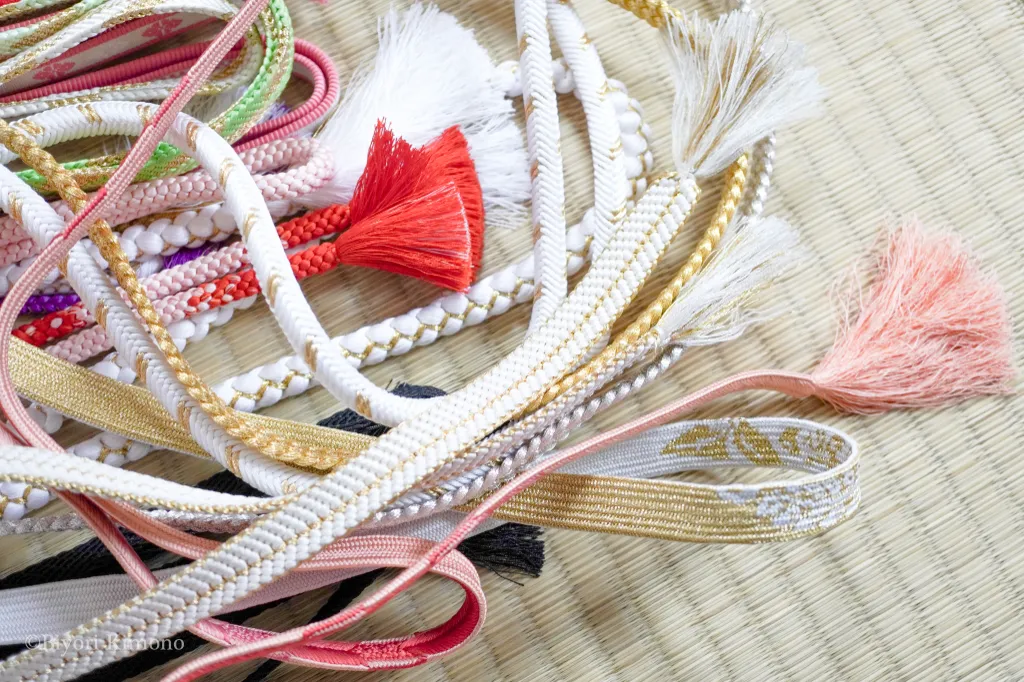
Obijime are a small detail, but they have a clear role in kimono styling.
If you understand just a few basic rules, choosing the right obijime becomes much easier.
In this post, I’ll explain the essentials using simple rules and real examples.
| Cord Width | Thread | Characteristics | Suitable Kimono | |
|---|---|---|---|---|
|
Formal Casual |
Thick (1.6 cm and above) |
Gold or Silver | Kurotomesode Irotomesode |
|
| Contains gold or silver | Furisode Houmongi Mon-tsuki Iromuji Mon-tsuki Edo Komon |
|||
| No gold or silver | Pure white | Irotomesode | ||
| Non-white | Tsukesage Iromuji (without crest) Edo Komon (without crest) |
|||
| Medium (1–1.5 cm) |
Contains gold or silver | |||
| No gold or silver | Flat braid (plain) | |||
| Flat braid with accents | Komon Tsumugi Wool Cotton Yukata |
|||
| Thin (under 1 cm) |
Round braid |
This table is an English translation of Kimono Sunao’s.
1. The Wider the Obijime, the More Formal It Is

One of the clearest indicators of formality is width.
A wider obijime creates a stronger visual presence and is typically used for more formal occasions. Thicker styles are often paired with formal kimono such as furisode or tomesode, where a certain level of structure and presence is expected.
Narrower obijime, on the other hand, feel lighter and more relaxed. They naturally suit everyday kimono and casual settings.
If you are unsure where to start, looking at the width alone already gives you a reliable direction.
These are the kinds of small details I usually go through step by step in my kimono dressing lessons, as they make a big difference in the overall balance.
2. Gold and Silver Threads Increase Formality

Another important element is the use of gold or silver threads.
These metallic accents add a sense of ceremony and refinement. Because of this, they are often used in more formal coordination. Even a small amount of gold or silver can shift the impression of the entire outfit.
Without these elements, the obijime feels more understated and is easier to incorporate into casual styling.
When combining pieces, it helps to think of gold and silver as a signal: the more present they are, the more formal the look becomes.
3. Thin Obijime Are Casual (But Very Versatile)

Thin obijime are often the easiest to wear.
They can be used throughout the year and work well with everyday kimono such as komon or tsumugi. Because they are less visually dominant, they blend naturally into more relaxed outfits.
At the same time, their simplicity means they are not typically chosen for formal occasions. With highly formal kimono, a thin obijime can feel slightly too light and informal.
Still, for daily wear, they are one of the most practical options.
4. Coarser Weaves Are for Summer

Beyond width and material, texture also plays a role.
Obijime with a tighter, denser braid are suitable across seasons and often appear more formal. In contrast, those with a looser, more open weave create a lighter impression.
This type of texture is commonly associated with summer. It visually suggests breathability and aligns with the seasonal feeling of summer kimono.
Even without changing color, the structure of the braid itself can communicate the season.
5. Pure White Obijime Have a Specific Role

White is a formal base color for obijime and is commonly used with kimono such as irotomesode. For higher formality, it is often combined with gold or silver.
They are traditionally worn with irotomesode and carry a very clean, formal impression. Because of this, their use is more specific compared to other colors.
Rather than being a versatile everyday choice, white is often reserved for particular formal contexts where clarity and restraint are important.
Putting It Together
In practice, most obijime choices come down to a few key elements.
Width sets the overall level of formality. The presence of gold or silver adds a sense of ceremony. Texture and color then refine the impression further.
If you match the formality of your obijime to your kimono, the coordination will usually feel balanced.
There are always exceptions in kimono styling, but these principles provide a reliable foundation to work from.
Putting It Together
In practice, most obijime choices come down to a few key elements.
Width sets the overall level of formality. The presence of gold or silver adds a sense of ceremony. Texture and color then refine the impression further.
If you match the formality of your obijime to your kimono, the coordination will usually feel balanced.
At the same time, these are guidelines—not strict rules. You don’t have to follow them if you don’t want to.
However, understanding TPO (time, place, occasion) and showing that awareness in your coordination often gives a quiet impression of good manners. Once you start paying attention to these details, choosing obijime becomes much more intuitive.
There are always exceptions in kimono styling, but these principles provide a reliable foundation to work from.
Leave a Reply