
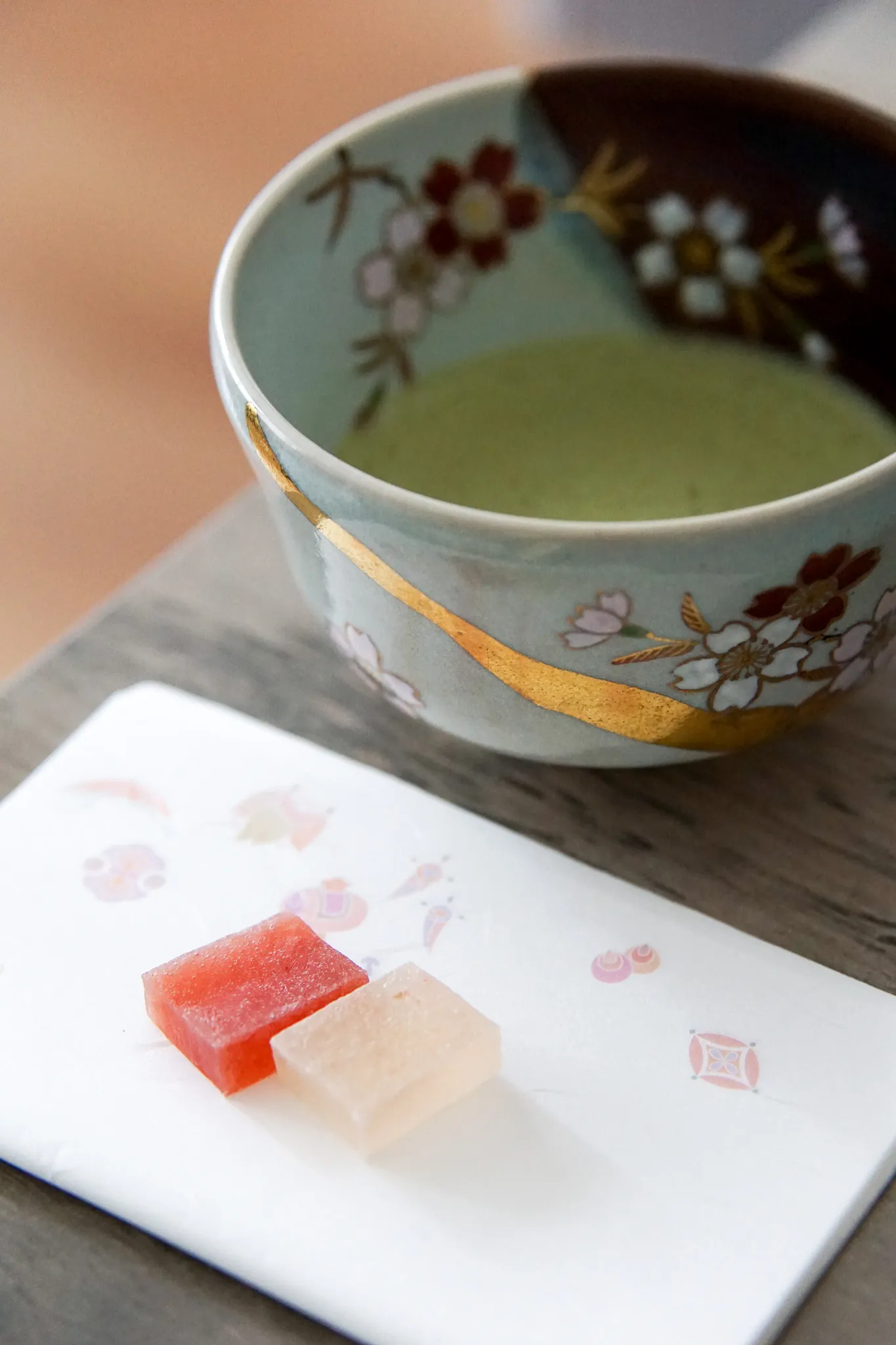
This workshop is shaped by over three years of studying Japanese tea ceremony (Urasenke), and I have received the permission (konarai) to continue my practice within this tradition.
Matcha has become very popular in recent years.
You see it everywhere — in cafés, desserts, and drinks often labeled as “ceremonial grade.”
But in many cases, the focus stays on the product itself, rather than how matcha is actually prepared and experienced.
For me, matcha became something quite different.
Through studying Japanese tea ceremony, I began to understand that matcha is not just about quality or labels — but about the process, the attention, and the small details that come together in a single bowl.
What Makes a Matcha Workshop Authentic?
You see it on packaging, in cafés, and in online shops — often presented as a sign of higher quality.
But traditionally, matcha was not defined this way.
There was no clear label that separated “ceremonial” from “non-ceremonial.”
Instead, the focus was on how the tea was handled and prepared.
What matters more is not just the matcha itself, but:
how it is prepared, how the tools are used, and how the moment is approached.
In traditional tea practice, even small details carry meaning.
The way the chasen is held, the temperature of the water, the movement of the whisk — these are not just techniques, but part of a shared understanding that has developed over time.
Without this context, matcha can easily become just another drink — something consumed quickly, without much thought.
With it, even a simple bowl of tea can feel complete.
An authentic matcha experience is not about strict rules or perfection.
It is about awareness, intention, and understanding the relationship between tea, tools, and the person preparing it.
This is the perspective that shapes how I approach matcha — and what I hope to share in a workshop setting.

Rooted in Japanese Tea Ceremony Practice
My approach is shaped by studying Japanese tea ceremony over the past three years.
I am currently learning within the Urasenke tradition and have received permission to study konarai, which focuses on the foundational procedures of preparing tea.
This experience has gradually changed how I see matcha.
It is not just about the quality of the tea itself, but about how it is prepared, how the tools are handled, and how attention is given to each step.
The workshops I am preparing are influenced by this background — not in a strict or formal way, but as a quiet foundation that shapes the experience.
It’s about slowing down, paying attention to small movements, and appreciating the interaction between tea and sweet.
What You Can Expect from a Matcha Workshop in Düsseldorf
The workshops I am preparing in Düsseldorf are designed to be small and personal.
They are not about performing a perfect tea ceremony, but about understanding the fundamentals in a clear and approachable way.
You would learn how to prepare matcha step by step, how to use tools like the chasen and chawan, and how to enjoy matcha together with seasonal wagashi.
It’s a quiet, hands-on experience — focused on doing, not just watching.
A Small, Personal Matcha Experience
The workshops are planned as small sessions with only a few participants.
This allows enough time to guide each person individually and creates a calm atmosphere.
Rather than a large class, it feels more like being invited into a quiet moment.
Matcha Workshop Düsseldorf – Coming Soon
I am currently preparing the first matcha workshops in Düsseldorf.
If you are looking for a more grounded and authentic introduction to matcha, you can:
→ follow along on Instagram: @wagashi.de
→ or check for updates here: https://biyori.de
I will share upcoming dates there once everything is ready.
A Small Note
Matcha does not need to be complicated.
But understanding where it comes from can change how you experience it — even in the simplest form.
Leave a Reply